Household tasks never ending is a feeling many people experience, especially when daily chores seem to reset faster than they are completed. No matter how much gets done, there is always something else waiting.
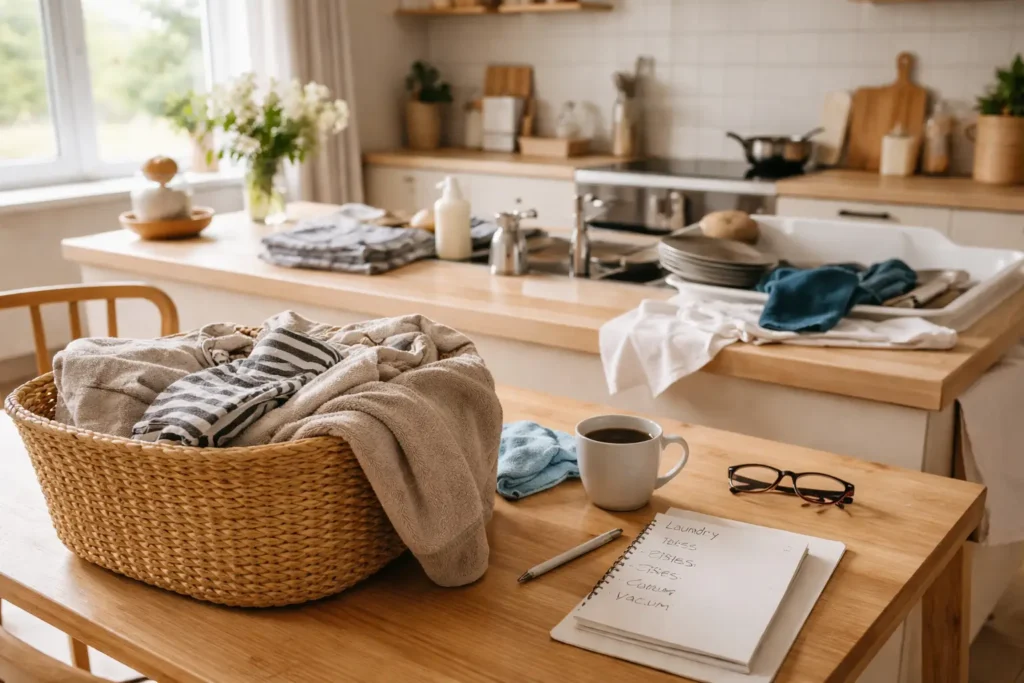
This creates a constant sense of unfinished work. Tasks like cleaning, laundry, and organizing never truly feel complete, which can make maintaining a home feel overwhelming.
The issue is not that there is too much to do—it is that the system behind these tasks is not designed to absorb the ongoing nature of daily life, something that becomes clearer when viewed through a complete home organization blueprint designed for long-term stability.
Household Tasks Never Ending: Why It Feels Constant
Household tasks never ending happens because most household activities are cyclical, not linear.
Unlike tasks that can be completed once and finished, household chores repeat continuously:
- dishes are used again
- laundry accumulates again
- surfaces are used again
- items are moved again
This repetition creates the impression that nothing is ever fully done.
The key issue is not the tasks themselves, but the lack of a structure that manages repetition effectively.
This recurring cycle is often a sign of deeper structural inefficiencies, a concept explored further in why home organization systems fail.
Hidden Causes Behind Never-Ending Household Tasks
There are underlying reasons why household work feels constant and exhausting.
Tasks Without Defined End Points
Many household tasks do not have clear completion markers.
For example:
- cleaning can always be extended
- organizing can always be improved
- tidying can always continue
Without clear limits, tasks feel endless.
Lack of System-Based Cycles
When tasks are handled randomly instead of within a system:
- work becomes reactive
- tasks pile up unexpectedly
- effort feels inconsistent
A lack of cycles creates instability.
Without structured cycles, tasks become reactive and inconsistent, often leading to environments that feel disorganized quickly, as seen in messy house even after cleaning.
Accumulation Between Tasks
Household work continues between cleaning sessions.
For example:
- dishes accumulate after being washed
- clothes pile up after being worn
- surfaces gather items after being cleared
This creates the feeling of constant reset.
This constant accumulation is one of the main reasons small tasks expand into larger workloads, a pattern closely related to why clutter builds up.
Overlapping Responsibilities
When multiple tasks are managed without structure:
- priorities become unclear
- tasks compete for attention
- nothing feels fully completed
This overlap increases mental load.
High Friction in Daily Actions
If completing tasks requires effort, they are delayed.
Common sources of friction include:
- complicated routines
- difficult access to tools
- unclear organization systems
Friction slows down completion and increases backlog.
Practical Systems to Make Household Tasks Manageable
To reduce the feeling that chores never end, the focus should shift from completing tasks to managing their flow.
Create Defined Task Cycles
Instead of handling tasks randomly, assign them to cycles.
For example:
- daily tasks
- weekly tasks
- periodic maintenance
This creates predictability and reduces overload.
Set Clear End Points
Define when a task is “done.”
For example:
- clean until surfaces are clear
- organize within specific limits
- stop tasks at a defined time
This prevents tasks from expanding indefinitely.
Reduce Task Overlap
Group similar tasks together.
For example:
- cleaning tasks in one block
- organizing tasks separately
- maintenance tasks scheduled
This reduces mental load and improves efficiency.
Simplify Daily Processes
Make tasks easier to complete.
This can include:
- reducing steps
- organizing tools effectively
- minimizing complexity
Simplification increases consistency.
Introduce Maintenance Instead of Reset
Instead of waiting for tasks to accumulate:
- maintain small areas regularly
- correct issues early
- prevent buildup
Maintenance reduces the need for large efforts.
These maintenance actions become significantly more effective when combined with a structured weekly home reset system that stabilizes household routines over time.
Simple Actionable Tips to Reduce Overwhelm
Small adjustments can make household tasks feel more manageable. A more structured way to apply these actions in daily life is to follow an ultimate home cleaning checklist that organizes essential tasks into simple, repeatable steps.
Focus on One Area at a Time
Trying to do everything at once increases overwhelm.
Working on one area creates progress and clarity.
Limit Daily Task Scope
Set a realistic amount of work per day.
This prevents burnout and creates consistency.
Use Time Blocks
Instead of task lists, use time limits.
For example:
- 15–20 minutes per task
- fixed cleaning windows
This makes tasks feel contained.
Accept Continuous Maintenance
Understanding that tasks repeat changes perspective.
Instead of trying to finish everything, focus on maintaining balance.
Reduce Unnecessary Work
Simplify routines and remove tasks that are not essential.
Less work makes systems easier to maintain.
Building a Sustainable Household System
The goal is not to eliminate tasks, but to create a system that makes them manageable. A more complete approach can be seen in a complete home cleaning system that organizes daily actions, weekly cycles, and long-term maintenance into a consistent structure.
This includes:
- aligning tasks with daily routines
- reducing friction
- creating predictable cycles
- maintaining consistency
When tasks are structured properly, they no longer feel overwhelming.
Conclusion
Household tasks never ending is not a result of too much work—it is a result of how that work is structured.
Because household tasks are naturally repetitive, they require systems that manage ongoing activity rather than attempt to eliminate it.
When you create clear cycles, simplify processes, and maintain small daily actions, tasks become more manageable.
Instead of feeling like chores never end, you create a system where work is controlled, predictable, and easier to sustain over time, especially when integrated into a complete daily, weekly and monthly home system designed for long-term stability.