Messy house even after cleaning is a frustrating experience that makes it feel like your effort disappears almost immediately. You clean, reset everything, and within hours—or even minutes—the house starts to look disorganized again.
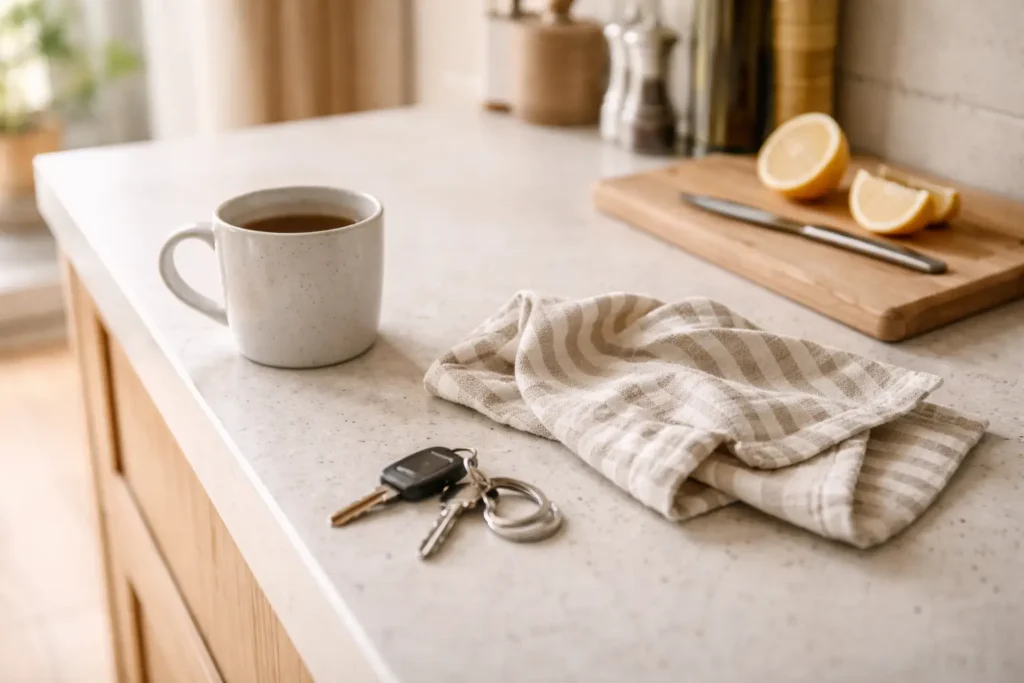
This creates the impression that something is wrong with your cleaning routine. But in reality, the problem usually isn’t how you clean—it’s what happens after you finish. This becomes clearer when you look at a complete home organization blueprint designed to maintain order beyond the initial reset.
A home does not stay organized simply because it was cleaned. It stays organized when there is a system that maintains the result.
Why a Messy House Even After Cleaning Keeps Happening
A messy house even after cleaning happens because cleaning is a temporary action, while daily life is continuous.
Cleaning removes visible mess, but it does not stop the behaviors and patterns that recreate it.
Throughout the day:
- items are used and not returned immediately
- surfaces are used as temporary storage
- objects move between rooms without structure
- small decisions are delayed
These actions are normal. But without a system that absorbs and organizes them, they accumulate quickly.
The key issue is not effort—it is the absence of a structure that maintains order between cleaning moments.
This structural gap is one of the main reasons systems break down over time, a pattern explored in more detail in why home organization systems fail.
Hidden Causes Behind a Messy House Even After Cleaning
There are underlying reasons why homes return to a messy state even after being cleaned. These causes are often invisible because they are embedded in daily habits and environmental design.
No Defined Flow of Movement
Homes naturally have flow—people move, use items, and transition between spaces.
When this flow is not supported by systems:
- items are dropped instead of placed
- objects accumulate in transition areas
- clutter forms along movement paths
Without structure, movement creates disorder.
This becomes especially noticeable in homes where disorder returns quickly, a dynamic often connected to why does clutter keep coming back?.
Surfaces Acting as Default Storage
Flat surfaces are the fastest way clutter becomes visible.
If there is no clear rule for what belongs on a surface:
- items collect gradually
- temporary placement becomes permanent
- visual clutter builds quickly
Surfaces without limits always become overloaded.
Lack of Return Behavior
Cleaning resets items, but daily life depends on returning them.
If returning items:
- requires effort
- is not intuitive
- is not immediate
then it will not happen consistently.
This creates a gap between cleaning and maintenance.
Systems That Are Too Complex
When organization systems require too much precision, they are difficult to sustain.
Examples include:
- overly detailed categorization
- rigid storage rules
- multi-step organization processes
Complexity reduces consistency.
Cleaning Without Reinforcement
Cleaning is often treated as a standalone task.
But without reinforcement:
- order fades quickly
- systems lose structure
- clutter returns faster each time
Cleaning must be supported by ongoing small actions.
Practical Systems That Prevent a Messy House Even After Cleaning
To stop the cycle, the focus must shift from cleaning to system design.
Create Immediate Return Paths
Every item should have a place that is:
- easy to access
- close to where it is used
- simple to maintain
If returning an item takes effort, it will be delayed.
Immediate return paths reduce accumulation.
Define Surface Boundaries
Instead of allowing surfaces to remain open, define limits.
For example:
- assign specific items to each surface
- use trays to group objects
- maintain visual boundaries
This prevents uncontrolled buildup.
Support Natural Movement
Observe how people move through the home.
Then:
- place storage along movement paths
- create drop zones where items naturally land
- reduce distance between use and storage
Systems should follow behavior, not fight it.
Introduce Continuous Maintenance
Maintenance should be built into daily life.
Examples include:
- quick resets after activities
- small corrections throughout the day
- consistent routines
These actions maintain order without requiring large effort.
These small maintenance actions become significantly more effective when combined with a structured weekly home reset system that stabilizes the home over time.
Simplify Everything
The simpler the system, the more likely it will be used.
Focus on:
fewer steps
broader categories
easy access
A simpler structure naturally improves consistency over time.
This principle is at the core of any low effort home system, where reduced complexity increases consistency and prevents long-term breakdown.
Simple Actionable Tips to Break the Cycle
If your home keeps getting messy after cleaning, you don’t need to clean more—you need to adjust how the system works.
Start With High-Impact Areas
Focus on spaces that affect the overall perception of order:
- kitchen counters
- living room surfaces
- entry areas
Keeping these areas clear reduces the visual impact of clutter.
Reduce Decision Fatigue
Make it easier to maintain order by reducing decisions.
For example:
- limit storage options
- standardize item placement
- simplify organization rules
Fewer decisions lead to faster action.
Use Time-Based Resets
Instead of waiting for mess to build up, use small scheduled resets.
Examples:
- end-of-day reset
- post-meal cleanup
- quick evening routine
These resets prevent accumulation.
Keep Essentials Accessible
If tools are difficult to reach, they will not be used.
Make sure:
- cleaning supplies are nearby
- storage is easy to access
- frequently used items are visible
Accessibility improves consistency.
Observe Patterns, Not Outcomes
Instead of reacting to mess, observe where it starts.
Look for:
- repeated clutter zones
- frequent friction points
- areas of accumulation
Fixing the cause is more effective than cleaning the result.
Conclusion
A messy house even after cleaning is not a sign of failure—it is a sign that the system supporting the home is incomplete.
Cleaning alone cannot maintain order. Without structure, daily life will always recreate mess.
When systems are built around real behavior, simplicity, and continuous maintenance, the home begins to stay organized more naturally over time.
Instead of constantly starting over, you create a stable environment where order is maintained through small, consistent actions rather than repeated effort.