Weekly habits for home organization help maintain a clean and functional home without requiring large cleaning sessions or time-consuming decluttering projects. In most households, organization is not the result of occasional effort but the outcome of small routines repeated consistently over time.
Many homes become disorganized not because people lack motivation to clean, but because small tasks accumulate throughout the week. Items move between rooms, surfaces collect objects, and everyday activities gradually disrupt the order of the space.
Developing simple weekly habits allows these small disruptions to be corrected before they grow into larger problems. Instead of waiting until the home feels chaotic, weekly routines maintain balance and structure.
Over time, these habits create a stable rhythm that keeps the home organized with far less effort.
Why Weekly Habits Matter for Household Order
Daily habits play an important role in maintaining a tidy home, but weekly habits address a different layer of household organization.
Many homes rely on small daily resets to maintain order throughout the week. Simple routines can prevent clutter from building up and make organization easier to maintain. If you want to build these routines, you can explore practical examples in daily habits that keep your home organized, which complement weekly organization systems.
While daily routines handle immediate tasks such as dishes, quick resets, or surface cleaning, weekly habits maintain the broader systems that support order within the home.
Throughout the week, small changes occur naturally:
- objects are moved from room to room
- storage areas become slightly disorganized
- papers and mail accumulate
- laundry cycles become inconsistent
None of these changes are significant individually, but together they slowly disrupt the structure of the home.
Weekly habits restore this structure.
They help maintain organization systems, reinforce storage patterns, and prevent clutter from spreading across multiple rooms.
When these routines become consistent, the home remains stable and predictable. Instead of reacting to disorder, households simply maintain existing systems.
Weekly Habits for Home Organization That Prevent Clutter
These weekly habits for home organization focus on maintaining structure rather than performing deep cleaning tasks.
Most of them require only a few minutes but significantly reduce the likelihood that clutter will accumulate.
Weekly routines work best when they are combined with short daily resets. Many households find that quick daily organization routines make weekly maintenance significantly easier. A practical example of this approach is the morning home reset routine, which helps prevent clutter from spreading throughout the day.
1. Reset Key Surfaces
Surfaces are one of the first areas where disorder becomes visible.
Kitchen counters, coffee tables, entry consoles, and desks naturally collect objects during the week.
A weekly surface reset involves:
- removing objects that do not belong
- returning items to their storage spaces
- clearing visual clutter
This simple habit restores visual calm and helps maintain a sense of order.
2. Return Items to Their Original Rooms
Objects frequently migrate between rooms during everyday life.
Books, chargers, clothing, dishes, and personal items often remain where they were last used.
Once a week, walking through the home and returning misplaced items to their correct rooms helps restore spatial organization.
This habit ensures that each room continues to function as intended.
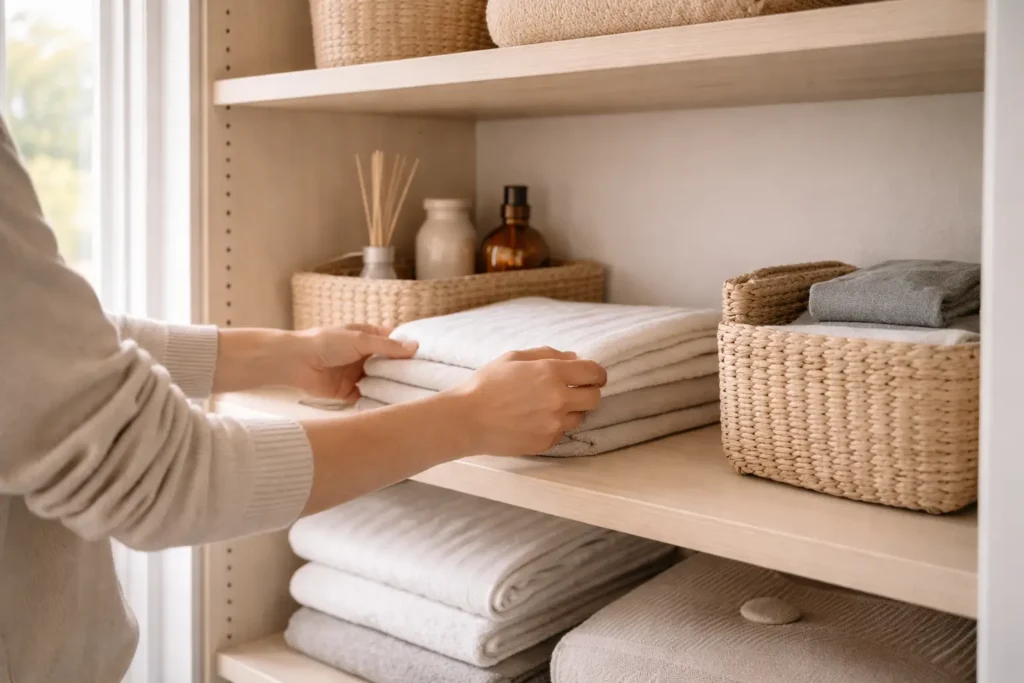
3. Review Storage Areas
Closets, baskets, drawers, and cabinets gradually lose structure when used repeatedly throughout the week.
A quick review may include:
- adjusting folded clothing
- straightening containers
- returning misplaced items
This habit helps storage systems remain efficient and prevents clutter from accumulating inside hidden spaces.
4. Organize the Entry Area
Entryways are high-traffic zones where daily items tend to gather.
Keys, bags, jackets, shoes, and mail are frequently placed in entry areas as people move in and out of the home.
A weekly entryway reset might include:
- discarding unnecessary papers
- returning seasonal items to storage
- organizing frequently used objects
Maintaining this space improves the overall flow of the home.
5. Reset the Laundry Flow
Laundry often becomes disorganized not because of volume but because of irregular routines.
A weekly reset might include:
- folding remaining items
- putting clothes back into closets
- clearing laundry baskets
This habit keeps the laundry cycle moving smoothly and prevents piles from forming.
6. Review Mail and Household Papers
Paper clutter is one of the most common sources of hidden disorder.
Mail, receipts, packaging inserts, and miscellaneous documents often accumulate during the week.
Once a week, taking a few minutes to:
- discard unnecessary papers
- recycle packaging
- organize important documents
can significantly reduce clutter.
Maintaining this habit prevents paper from spreading across multiple areas of the home.
7. Re-Align Kitchen Organization
The kitchen is one of the most frequently used spaces in any home.
Because of constant use, small disruptions often occur throughout the week.
A weekly kitchen reset may include:
- returning utensils to their proper drawers
- reorganizing pantry items
- clearing expired food from the refrigerator
These adjustments maintain the kitchen’s functionality and help keep daily routines efficient.
8. Reset Shared Living Spaces
Living rooms and family spaces are used by multiple people throughout the week.
Because of this, objects frequently shift positions and small items accumulate.
A weekly reset may include:
- folding blankets
- adjusting cushions
- organizing decorative objects
- returning misplaced items
These small actions restore comfort and visual balance to shared spaces.
9. Maintain Household Cleaning Tools
Maintaining the tools used for organization is often overlooked.
Cleaning supplies, vacuum containers, and cloths require occasional attention to remain functional.
A weekly habit may include:
- emptying vacuum containers
- rinsing cloths and cleaning tools
- restocking basic supplies
When tools remain ready for use, organization tasks become easier to perform.
10. Prepare the Home for the Coming Week
A final weekly habit is preparing the home for the days ahead.
This habit might include:
- clearing surfaces used for work or school
- organizing frequently used items
- preparing storage areas
Preparing the home in advance helps the following week begin smoothly.
How to Apply Weekly Habits in Daily Life
The effectiveness of weekly organization habits depends on consistency rather than perfection.
Some households also benefit from pairing weekly organization habits with simple evening routines. Short end-of-day resets help maintain the systems created during the week. One example is a nightly home reset routine, which restores order before the next day begins.
Many households find it helpful to attach these routines to a specific moment in the week.
Common options include:
- Saturday morning resets
- Sunday afternoon organization
- Friday evening preparation for the next week
Choosing a consistent time helps transform the routine into a habit.
Some households prefer to complete all weekly tasks at once, while others distribute them across several days.
For example:
- one day for entry areas
- one day for kitchen organization
- one day for storage spaces
This flexible approach allows routines to adapt to different schedules.
Creating Sustainable Organization Systems
Weekly habits function best when they are combined with daily and monthly routines, especially when supported by a long-term home maintenance system that keeps these layers connected over time.
Over time, combining daily, weekly, and monthly routines creates a more stable organization system. Larger resets can help restore balance when smaller routines are not enough. Many households use a monthly home organization checklist to review spaces and maintain long-term organization.
Daily habits handle immediate tasks such as quick resets or surface clearing.
Weekly habits maintain broader organizational systems.
Monthly routines address deeper tasks such as seasonal storage adjustments or decluttering.
When these layers work together, maintaining an organized home becomes far easier.
Instead of relying on occasional large cleaning efforts, the home benefits from small adjustments made regularly.
Conclusion
A consistently organized home is rarely the result of occasional deep cleaning. Instead, it is the outcome of small routines practiced over time.
Developing weekly habits for home organization helps households maintain structure, prevent clutter, and preserve functional living spaces.
These habits require little time individually, but together they create a stable rhythm that keeps the home balanced and manageable.
When practiced consistently, weekly habits transform organization into a natural part of daily life rather than a stressful task.