Hard to keep house organized is a common frustration, especially when it feels like no matter how much effort you put in, the results don’t last. You clean, organize, and reset your space—only to see it return to disorder shortly after.
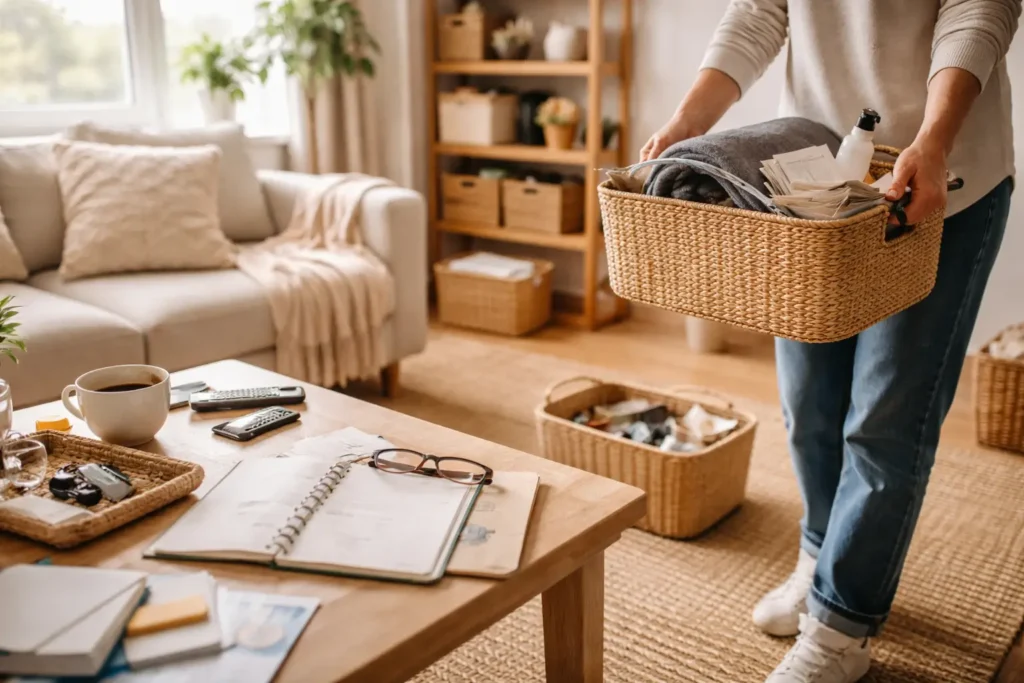
This creates the impression that maintaining an organized home requires constant effort. But in most cases, the issue is not about working harder. It is about understanding why organization does not hold over time.
A home does not stay organized because it was cleaned once. It becomes easier to understand when viewed through a complete home organization blueprint designed to maintain order beyond the initial reset.
Hard to Keep House Organized: Why It Feels So Difficult
Hard to keep house organized happens because homes are dynamic environments.
Every day:
- items are used
- objects move between spaces
- surfaces are occupied
- routines shift
This constant movement creates instability.
Without a structure that manages this movement, organization breaks down quickly.
This recurring pattern is often linked to deeper structural inefficiencies, a concept explored further in why home organization systems fail.
The difficulty is not in organizing—it is in maintaining organization between moments of order.
Hidden Causes That Make It Hard to Stay Organized
There are several underlying reasons why organization feels difficult to maintain.
Systems That Don’t Match Daily Behavior
Many organization systems are designed based on ideal scenarios, not real habits.
When systems do not match how people actually use their space:
- items are not returned
- processes are ignored
- organization breaks down
Systems must adapt to behavior, not the other way around.
Too Much Friction in Daily Actions
If maintaining order requires effort, it will not happen consistently.
Examples of friction include:
- storage that is hard to access
- complicated organization systems
- too many steps to complete a task
Friction slows down maintenance and increases clutter.
When daily actions become difficult to complete, tasks begin to pile up, often creating the feeling that work never ends, as explained in household tasks never ending.
Lack of Defined Boundaries
Without clear limits, spaces expand to accommodate more items.
For example:
- surfaces become storage areas
- drawers overflow
- closets become crowded
Boundaries are what prevent accumulation.
Accumulation Between Cleaning Moments
Even when a home is cleaned, daily activity continues.
Items are:
- used again
- moved again
- placed again
Without ongoing correction, clutter builds up naturally.
This continuous accumulation is one of the main reasons disorder returns so quickly, a pattern closely related to why clutter builds up.
Overcomplicated Organization Systems
Complex systems are difficult to maintain over time.
Examples include:
- overly detailed categorization
- strict storage rules
- rigid organization methods
Complexity reduces consistency.
Practical Systems That Make Organization Easier
To make it easier to keep a house organized, the focus should be on reducing friction and supporting natural behavior.
Simplify Storage Systems
Storage should be:
- easy to access
- intuitive to use
- simple to maintain
The simpler the system, the more likely it will be used consistently.
Create Clear Zones for Activities
Divide the home into functional areas based on use.
For example:
- relaxation areas
- work areas
- storage areas
Each zone should have clear boundaries and defined items.
Reduce the Number of Decisions
The more decisions required, the harder it is to maintain order.
Simplify by:
- limiting storage options
- standardizing placement
- reducing complexity
Fewer decisions lead to faster action.
Introduce Continuous Maintenance
Instead of relying on occasional cleaning:
- maintain small areas regularly
- correct issues early
- prevent buildup
Maintenance keeps systems stable.
These maintenance actions become significantly more effective when combined with a structured weekly home reset system that stabilizes the home over time.
Align Systems With Real-Life Use
Observe how your home is actually used.
Then:
- place storage where items naturally land
- adjust systems to match routines
- reduce unnecessary steps
Alignment improves consistency.
Simple Actionable Tips to Keep Your House Organized
Small changes can make a big difference in maintaining order.
Focus on High-Impact Areas
Start with areas that affect the overall perception of the home:
- kitchen surfaces
- living spaces
- entry points
Keeping these areas organized creates immediate visual improvement.
Avoid Temporary Placement
Temporary placement often becomes permanent.
Putting items away immediately prevents accumulation.
Reset Small Areas Daily
Short resets are more effective than large, infrequent cleaning sessions.
Focus on:
- clearing surfaces
- returning key items
- maintaining visible areas
Consistency prevents buildup.
Simplify What You Own
The more items you have, the more difficult it is to manage them.
Reducing excess makes organization easier and more sustainable.
Observe Patterns Instead of Reacting
Instead of reacting to clutter, identify where it starts.
Look for:
- recurring clutter zones
- repeated behaviors
- friction points
Fixing the cause is more effective than cleaning the result.
Building a System That Sustains Organization
The goal is not to create a perfectly organized home, but a system that supports ongoing use.
This includes:
- reducing friction
- simplifying processes
- defining boundaries
- maintaining consistency
When systems are designed properly, organization becomes easier to sustain.
Conclusion
Hard to keep house organized is not a personal failure—it is a structural issue.
Homes are constantly in motion, and without systems that support this movement, organization will not last.
When you simplify systems, reduce friction, and align your home with real behavior, maintaining order becomes more natural.
Instead of constantly starting over, you create a home that stays organized with less effort and more consistency over time, especially when integrated into a complete daily, weekly and monthly home system designed for long-term stability.